
WELL Health Diagnostic Centres

Diagnostic Tests

Echocardiogram

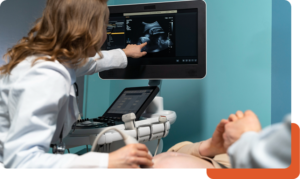
An echocardiogram (ECHO) uses ultrasound waves to produce images of your heart. This commonly used test allows your doctor to see your heart beating and pumping blood. Your doctor can use the images from an echocardiogram to identify heart disease.

Your doctor may suggest an echocardiogram if he or she suspects problems with the valves or chambers of your heart or if heart problems are the cause of symptoms, such as shortness of breath or chest pain. An echocardiogram can also be used to detect congenital heart defects in unborn babies.


Depending on what information your doctor needs, you may have 1 of these 4 echocardiograms:

  • Transthoracic Echocardiogram: This is a standard, non-invasive echocardiogram. A technician (sonographer) spreads gel on your chest and then presses a device known as a transducer firmly against your skin, aiming an ultrasound beam through your chest to your heart. The transducer records the sound wave echoes from your heart, and a computer converts the echoes into moving images on a monitor. If your lungs or ribs block the view, you may need a small amount of liquid (contrast agent) injected through an IV to improve the images of your heart’s structure on a monitor.


  • Transesophageal Echocardiogram: If it’s difficult to get a clear picture of your heart with a standard echocardiogram, or if there’s a reason to see the heart and valves in more detail, your doctor may recommend a transesophageal echocardiogram. In this procedure, a flexible tube containing a transducer is guided down your throat and into your esophagus, which connects your mouth to your stomach. From there, the transducer can be positioned to obtain more-detailed images of your heart.


  • Doppler Echocardiogram: When sound waves bounce-off blood cells moving through your heart and blood vessels, they change pitch. These changes (Doppler signals) can help your doctor measure the speed and direction of the blood flow in your heart. Doppler techniques are used in most transthoracic and transesophageal echocardiograms, and they can be used to check blood flow problems and blood pressures in the arteries of your heart that traditional ultrasound might not detect. Sometimes the blood flow shown on the monitor is colorized to help your doctor pinpoint any problems.


  • Stress Echocardiogram: Some heart problems, particularly those involving the coronary arteries that supply blood to your heart muscle, occur only during physical activity. For a stress echocardiogram, ultrasound images of your heart are taken before and immediately after walking on a treadmill or riding a stationary bike. If you’re unable to exercise, you may get an injection of a medication to make your heart pump as hard as if you were exercising.
Echocardiogram

An echocardiogram (ECHO) uses ultrasound waves to produce images of your heart. This commonly used test allows your doctor to see your heart beating and pumping blood. Your doctor can use the images from an echocardiogram to identify heart disease.

Your doctor may suggest an echocardiogram if he or she suspects problems with the valves or chambers of your heart or if heart problems are the cause of symptoms, such as shortness of breath or chest pain. An echocardiogram can also be used to detect congenital heart defects in unborn babies.