Preparation for an ultrasound depends on the type of scan your physician ordered. Some scans require fasting. Others need a full bladder. A few need neither. Getting the instructions right before you arrive directly affects image quality, and even if the scan can proceed.
Why Preparation Matters for Ultrasound Imaging
Ultrasound uses sound waves to produce images of internal structures. Food, gas, and a partially filled or empty bladder all interfere with how those waves travel through the body. According to General Ultrasound Imaging on RadiologyInfo.org, a resource reviewed by the Radiological Society of North America and the American College of Radiology, preparation steps are specific to scan type because each exam targets different structures with different imaging requirements.
A missed or incomplete preparation step can result in unclear images. In some cases, the scan cannot be completed and needs to be rescheduled. Following the instructions your clinic provides protects both your appointment and the accuracy of your results.
How to Prepare for an Ultrasound Based on Test Type
The Ultrasound Test Preparation guide published by Well Diagnostics outlines specific requirements for each scan type. What applies to one scan may not apply to another, so review your specific instructions before the day of your appointment.
Abdominal Ultrasound
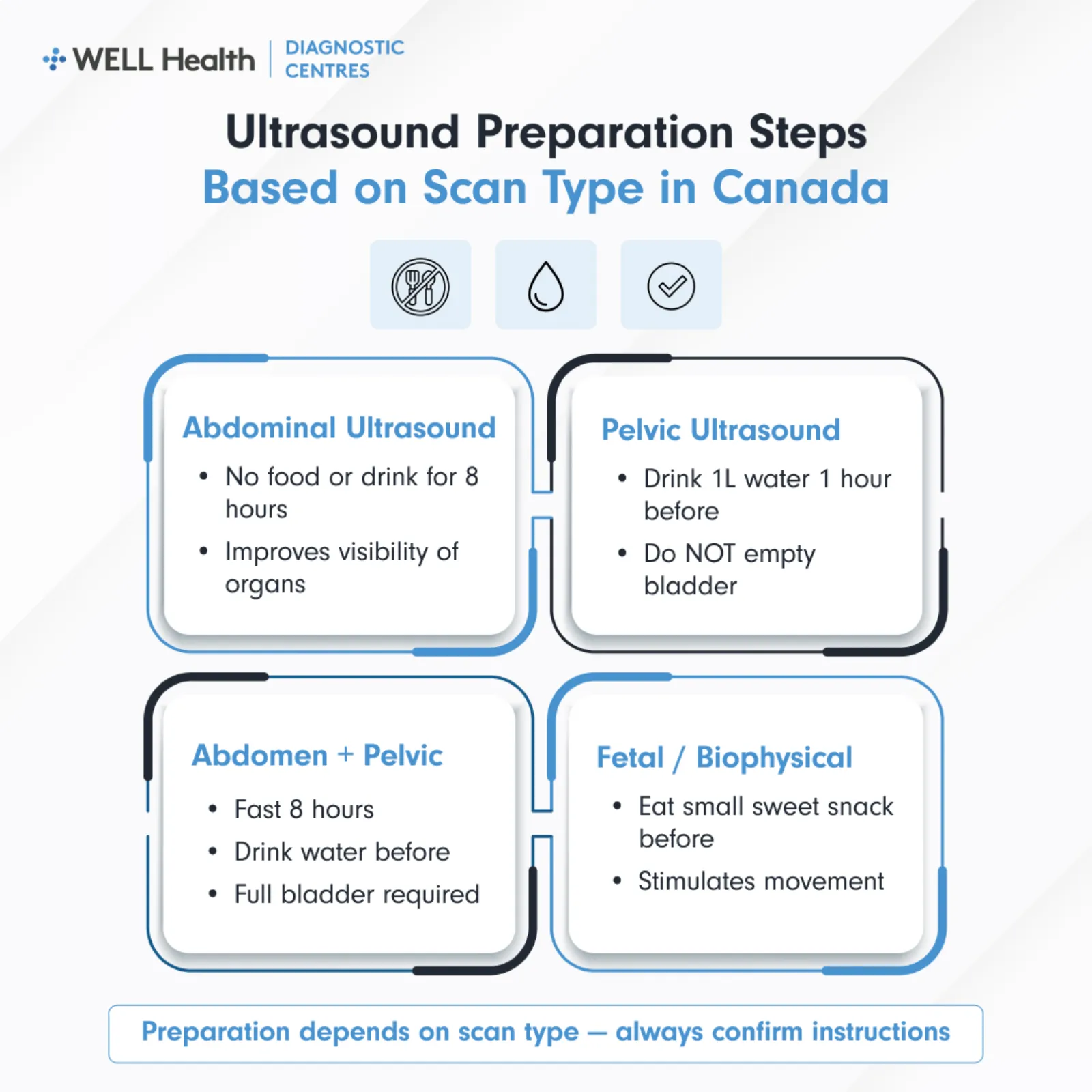
No eating, drinking, smoking, or chewing gum for 8 hours before the appointment. This applies to standalone abdominal scans and hernia scans. Fasting keeps the stomach empty and allows the gallbladder to fill, which improves visibility of the liver, pancreas, and bile ducts.
Pelvic Ultrasound
No fasting required. The Ultrasound Test Preparation guide specifies that pelvic ultrasound patients must drink 34 oz (1 litre) of water one hour before the appointment and must not empty their bladder before the exam. A full bladder acts as an acoustic window, improving visibility of pelvic organs.
Abdomen and Pelvic Combined
Both fasting and hydration apply here. No eating or drinking for 8 hours before the appointment, and you must drink 34 oz (1 litre) of water one hour before the exam. Do not empty your bladder before arriving.
Fetal Growth and Biophysical Profile
This scan has a different requirement from the rest. The Ultrasound Test Preparation guide instructs patients to eat or drink a sweet snack 10 minutes before the appointment. A piece of fruit, a chocolate bar, or a small juice works. This helps stimulate fetal movement for the biophysical assessment.
Thyroid, Breast, Scrotum, Extremity, and Vascular
No preparation is required for these scan types. You can eat and drink normally before these appointments. It is still worth confirming with your clinic, as individual referral instructions may differ.
How to Prepare for an Ultrasound Appointment in Canada
Beyond fasting and hydration, several logistical steps apply to every ultrasound appointment. The Ultrasound Test Preparation guide lists the following for all patients, regardless of scan type.
- Arrive 15 minutes early: This allows time for check-in, paperwork, and any last-minute questions.
- Bring your health card: A valid provincial health card is required at every appointment.
- Bring your requisition: If your physician gave you a signed requisition form, bring it with you.
- Bring your medication list: If applicable, carry a current list of all medications you take.
- Wear comfortable clothing: General Ultrasound Imaging on RadiologyInfo.org recommends loose-fitting clothing that allows easy access to the scan area.
- Leave jewelry at home: Remove jewelry from the area being examined or leave it at home to avoid delays.
- Give 24-hour cancellation notice: Missed appointments are charged a cancellation fee and the referring physician is notified.
Fasting, Hydration, and Medication Guidelines
Fasting and hydration rules are the most frequently misunderstood part of ultrasound preparation instructions. Here is what each term means in practice.
Fasting Before an Ultrasound
Fasting means no food, drinks, smoking, or chewing gum for the specified period before your scan. The Abdominal Ultrasound Exam page on RadiologyInfo.org notes that patients scheduled for scans of the liver, gallbladder, spleen, and pancreas may be asked to eat a fat-free meal the evening before and then avoid eating for 8 to 12 hours before the exam. Small sips of water to take daily medication are generally permitted. Confirm this with your clinic.
Drinking Water Before an Ultrasound
Hydration requirements differ sharply by scan type. Abdominal scans restrict fluids. Pelvic scans require them. The Ultrasound Test Preparation guide specifies that pelvic ultrasound patients must drink a full litre of water one hour before the exam without emptying the bladder. Avoid carbonated drinks, coffee, and juice during the preparation window, as these can increase gas and interfere with imaging.
Medications
Most medications can be taken as normal before an ultrasound. For fasting diabetic patients, the Ultrasound Test Preparation guide notes that a piece of plain toast and a glass of orange juice are permitted if needed. Check with your referring physician or imaging clinic if your medications involve specific timing or dietary restrictions.
What to Bring to Your Appointment
The Ultrasound Test Preparation guide lists the following items for every patient attending an ultrasound appointment.
- Valid health card: Required for all OHIP-covered diagnostic imaging in Ontario.
- Signed requisition: Bring the referral form from your physician if one was provided.
- Medication list: A written list of current medications helps if the clinical context is needed on the day.
- Previous imaging: Bring prior ultrasound, CT, or MRI reports or images if relevant to your current scan.
- Caregiver or support: If you have mobility concerns, bring someone to assist you during the visit.
What Happens If Preparation Is Incomplete
Incomplete preparation affects image quality directly. The General Ultrasound Imaging resource on RadiologyInfo.org explains that air in the bowel and gas in the digestive tract obstruct the sound waves used in ultrasound imaging. This is most relevant for abdominal scans where the gallbladder, pancreas, and liver need to be clearly visible.
Arriving without having fasted means the sonographer may not be able to complete the scan. For pelvic scans, an empty bladder has the same result. In both cases, rescheduling is likely, which delays your diagnostic report and your physician’s ability to act on the findings.
Key Takeaways
- Preparation varies by scan type: Fasting, hydration, and bladder requirements all depend on what is being imaged.
- Fasting applies to abdominal scans: No food or drink for 8 hours before abdomen, hernia, or combined abdomen and pelvic scans.
- Full bladder for pelvic scans: Drink 1 litre of water one hour before and do not empty your bladder before the exam.
- No prep for some scans: Thyroid, breast, scrotum, extremity, and vascular ultrasounds require no preparation.
- Arrive 15 minutes early: Bring your health card, signed requisition, and any medication list.
Frequently Asked Questions
Do I need to fast before every ultrasound in Canada?
No. Fasting applies to specific scan types only. The Ultrasound Test Preparation guide confirms that abdominal, hernia, and combined abdomen and pelvic scans require 8 hours of fasting. Thyroid, breast, scrotum, extremity, vascular, and pelvic-only scans do not. Always check the preparation instructions specific to your referral.
How much water should I drink before a pelvic ultrasound?
The Ultrasound Test Preparation guide specifies drinking 34 oz (1 litre) of water one hour before the appointment. Do not empty your bladder before the exam. A full bladder improves image clarity by acting as an acoustic window for the transducer.
Can I take my medication before an ultrasound?
In most cases, yes. The Ultrasound Test Preparation guide notes that fasting diabetic patients can eat a small snack if needed. For other medications, take them with as little water as possible during the fasting window and confirm specifics with your imaging clinic at booking.
Prepare correctly, and Your Scan Can Proceed Without Delays
Ultrasound preparation in Canada follows clear, scan-specific guidelines. Fasting, hydration, and what you bring to your appointment all affect image quality and if the scan proceeds. Review your preparation instructions before your appointment, and contact the imaging clinic directly if anything is unclear.