Heart disease is the leading cause of death among Canadian women, yet it continues to be under-recognized and under-tested in female patients. Women often experience cardiovascular conditions differently from men, which can lead to delays in diagnosis and follow-up care. Understanding the most common cardiovascular concerns in women is an important first step toward getting the right assessment at the right time.
Why Cardiovascular Health in Women Deserves Focused Attention
Cardiovascular research was conducted predominantly on male subjects for quite some time. The typical “classic” heart attack symptoms, like sharp chest pain spreading to the left arm, are more often seen in men. Women are more likely to experience subtler symptoms that are easy to attribute to stress, fatigue, anxiety, or digestive problems.
In Canada, heart disease and stroke account for nearly one in four female deaths. Hormonal changes across a woman’s life, including those tied to pregnancy, perimenopause, and menopause, introduce cardiovascular risks that do not affect men in the same way.
Recognizing these concerns early and following through with appropriate diagnostic testing plays a significant role in clinical outcomes.
Common Cardiovascular Concerns in Women
The following conditions represent the cardiovascular concerns most commonly seen in female patients across clinical and diagnostic settings in Canada.
1. Coronary Artery Disease (CAD)
Coronary artery disease (CAD) happens when the arteries supplying blood to the heart become narrowed over time due to plaque buildup. In women, this condition often develops more gradually and presents with atypical symptoms such as unusual fatigue, nausea, or jaw and neck pain rather than classic chest pressure.
Women are also more likely to have non-obstructive CAD, where arteries appear clear on standard imaging but still function abnormally. As a result, this makes it harder to detect during routine assessment.
2. Heart Failure
Heart failure occurs when the heart is not able to pump blood efficiently to meet the body’s needs. Women mostly develop heart failure with preserved ejection fraction compared to men. This is a form where the heart muscle stiffens rather than weakens.
Common symptoms include breathlessness with minimal activity, ankle swelling, and persistent fatigue. These symptoms are frequently attributed to other causes in women, which can result in a delayed cardiac workup.
3. Arrhythmia and Atrial Fibrillation
Arrhythmias are abnormal heart rhythms that affect the rate or pattern of the heartbeat. Atrial fibrillation, the most common sustained arrhythmia, causes the upper chambers of the heart to beat in an irregular and often rapid pattern.
Women with atrial fibrillation carry a higher risk of stroke than men with the same condition, and their symptoms, including palpitations, dizziness, and shortness of breath, are more often dismissed or attributed to anxiety or hormonal shifts.
4. Spontaneous Coronary Artery Dissection (SCAD)
Spontaneous coronary artery dissection (SCAD) is a condition in which the inner lining of a coronary artery tears, restricting blood flow to the heart. It disproportionately affects women, particularly younger women and those who have recently given birth.
SCAD can present like a standard heart attack, and awareness of this condition has grown considerably in clinical settings over recent years. It is worth discussing with a physician if you are a woman under 50 who has experienced sudden chest pain or cardiac symptoms.
5. Hypertension
High blood pressure is one of the main causes of heart disease and stroke in women. While hypertension affects both sexes, women face distinct blood pressure risks tied to oral contraceptive use.
Pregnancy complications such as preeclampsia and hormonal changes during menopause are also major causes of hypertension. Women who develop high blood pressure during pregnancy carry a significantly elevated lifetime cardiac risk, even if their blood pressure returns to normal after delivery.
6. Cardiac Microvascular Disease
Cardiac microvascular disease affects the small vessels of the heart and is more common in women than in men. Because it does not always appear on standard coronary imaging, it has historically been underdiagnosed in female patients.
Women who experience chest pain and show no obstructive disease on an imaging report may still have clinically significant microvascular dysfunction that requires a more targeted assessment approach.
Heart Disease Symptoms in Women to Know
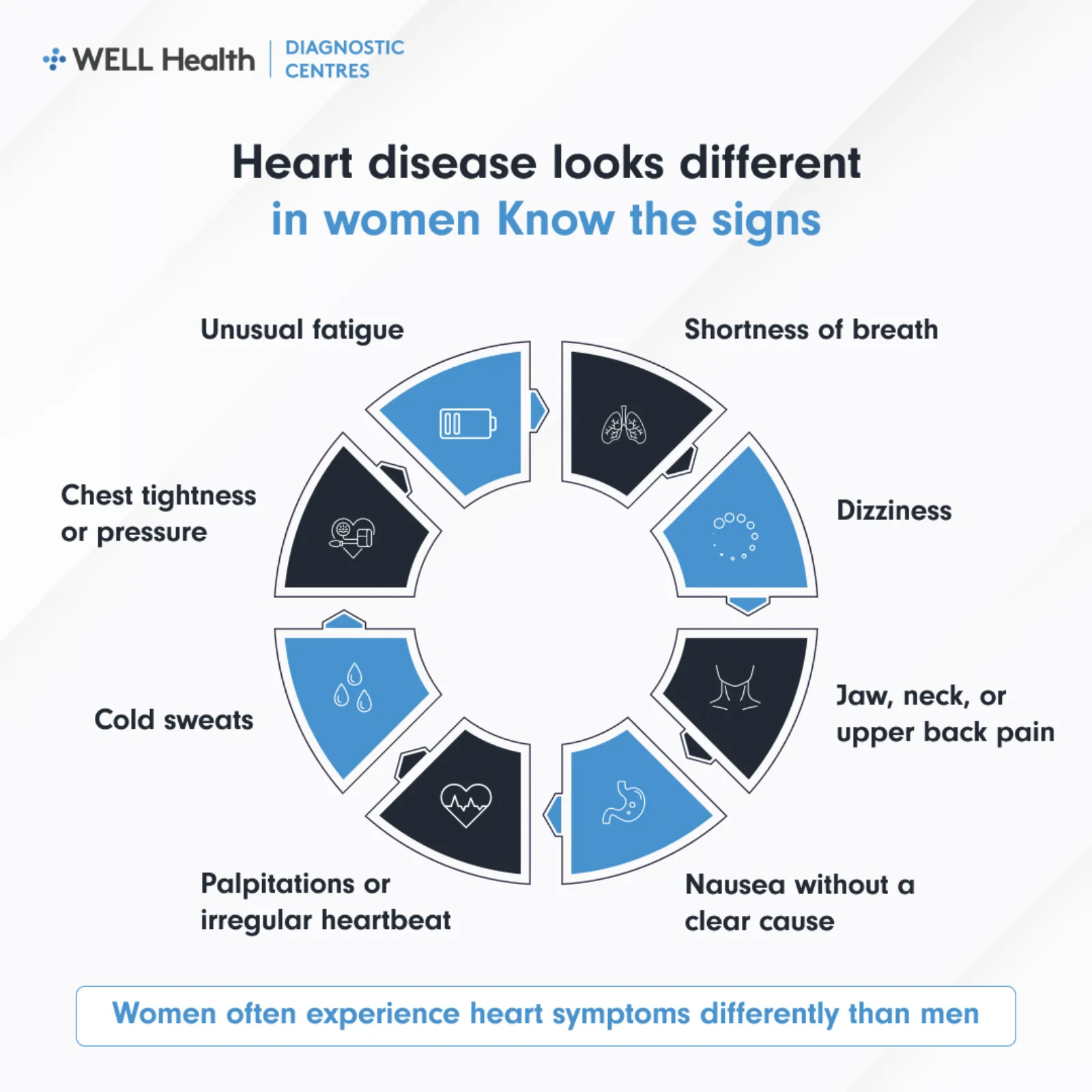
Women often experience heart-related symptoms differently from the classic signs usually taught in medical education. The following symptoms, particularly when they are new, recurring, or occurring in combination, are worth bringing to a physician’s attention.
- Unexplained Fatigue: Feeling unusually tired or drained even after enough rest or little activity.
- Breathing Difficulty: Shortness of breath during rest or simple daily activities.
- Chest Discomfort: Pressure, tightness, heaviness, or pain felt in the chest area.
- Radiating Pain: Pain or discomfort spreading to the jaw, neck, back, or shoulders.
- Stomach Distress: Nausea, indigestion, or stomach discomfort without an obvious cause.
- Heart Palpitations: Feeling like the heart is racing, fluttering, or beating irregularly.
- Lightheadedness: Feeling dizzy, faint, or unsteady unexpectedly.
- Cold Sweating: Sudden cold sweats without heat, exercise, or a clear trigger.
These symptoms do not confirm a cardiac condition on their own, but they indicate that cardiac causes should be assessed and ruled out through proper testing. Women are encouraged to speak with their physician about a referral for cardiac diagnostic testing if any of these symptoms are present or recurring.
Women’s Cardiac Risk Factors to Discuss With Your Physician
In addition to shared risk factors such as smoking, diabetes, and a family history of heart disease, women carry several cardiovascular risk factors that are either unique to them or carry greater clinical weight in female patients.
- Pregnancy High Blood Pressure: High blood pressure during pregnancy can increase the risk of heart disease and stroke later in life.
- Early Menopause: Menopause before age 40 may raise the risk of heart problems in the future.
- Autoimmune Diseases: Conditions like lupus and arthritis can increase heart disease risk.
- Hormonal Contraceptives: Birth control combined with smoking or high blood pressure may raise the risk of clots and hypertension.
- Gestational Diabetes: Diabetes during pregnancy can increase the chance of type 2 diabetes and heart disease later on.
- Stress and Depression: Long-term stress and depression can negatively affect heart health.
When Cardiac Testing Is Recommended for Women
A physician may recommend cardiac diagnostic testing when symptoms are present, when risk factors have been identified during a routine assessment, or as part of a broader cardiovascular evaluation. The type of testing will depend on the clinical picture and what the physician is looking to assess.
Common cardiac tests ordered for women include an electrocardiogram (ECG), an echocardiogram, a Holter monitor worn over 24 to 48 hours, an exercise stress test, a cardiac event monitor, and a chest X-ray.
At WELL Health Diagnostic Centres, cardiac testing requires a signed requisition from a referring physician or healthcare provider. If you are experiencing symptoms or have been identified as having cardiovascular risk factors, speak with your family doctor or a walk-in clinic physician about whether a referral for cardiac diagnostic testing is appropriate.
Can I book cardiac testing at WELL Diagnostics without a referral?
Most cardiac diagnostic tests at WELL Health Diagnostic Centres require a signed requisition from a referring healthcare provider. If you have concerns about your heart health, speak with your family doctor or a walk-in clinic physician who can assess your symptoms and provide a referral if one is needed.
Are heart disease symptoms in women always different from men?
Not always. Some women do experience classic chest pain. However, research consistently shows that women are more likely to present with atypical symptoms such as fatigue, jaw pain, or nausea, which can lead to delays in seeking care. Any new or unexplained symptom should be evaluated by a physician.
At what age should women start thinking about heart health screening?
Risk discussions are appropriate at any age if risk factors are present. For most women without symptoms or known risk factors, cardiovascular risk assessment typically comes up around age 40 to 50 or after menopause. Women with a history of pregnancy complications, autoimmune conditions, or a family history of early heart disease may benefit from an earlier conversation with their physician.
Is a normal ECG enough to rule out heart disease in women?
A normal ECG provides useful information but does not rule out all forms of heart disease. ECGs detect electrical irregularities, but conditions such as microvascular disease, early coronary artery disease, or structural changes may not be visible on an ECG alone. Your physician will determine whether additional imaging or monitoring is needed based on your full clinical picture.
Does menopause raise the risk of heart disease?
Yes. The decline in estrogen during menopause is linked to changes in cholesterol levels, blood pressure, and arterial function, all of which can increase cardiovascular risk over time. Women who go through early menopause before age 40 face a particularly elevated risk and should discuss cardiac monitoring options with their physician.
Taking Charge of Your Heart Health
Understanding how heart disease shows up in women is a powerful first step toward better care. Because symptoms and risk factors can look different compared to what’s commonly expected, they’re sometimes missed or dismissed. Knowing what to watch for and when to ask for cardiac testing can make a real difference in getting timely support and treatment. If something feels off, trust it and speak with a healthcare provider.