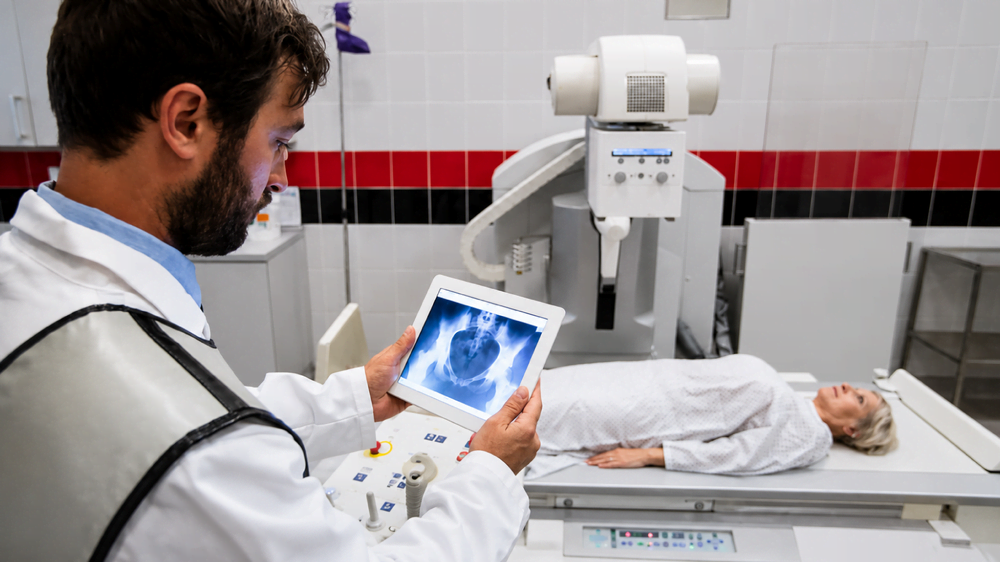
A bone density test uses low-dose X-ray to quantify the mineral content of bone tissue, most commonly at the hip and lumbar spine. The result is expressed as a T-score or Z-score, each of which compares your bone mineral density to a different reference group. Physicians use these scores alongside your age, fracture history, and other risk factors to assess your risk of future fracture and guide decisions about treatment.
Key Takeaways
- T-score classifies bone density: Above -1.0 is normal; between -1.0 and -2.5 is osteopenia; -2.5 or below is osteoporosis.
- Z-score applies to younger patients: Used in premenopausal women and men under 50 to compare to age-matched peers.
- T-score alone is not sufficient: Fracture risk depends on age, fall history, prior fractures, and other clinical factors alongside the score.
- FRAX adds context: The 10-year fracture probability tool incorporates bone density with clinical risk factors to guide treatment decisions.
- Follow-up testing is individualized: Repeat DXA timing depends on your risk level, treatment status, and proximity to the intervention threshold.
What a Bone Density Test Assesses
The most widely used test is a DXA scan, Dual-Energy X-ray Absorptiometry. According to the National Institute of Arthritis and Musculoskeletal and Skin Diseases, DXA measures calcium and other minerals in bone at the hip and spine, which are the sites most prone to osteoporotic fracture. The scan is non-invasive, quick, and exposes patients to a very small amount of radiation, far less than a standard chest X-ray.
Bone Density Test Results: Score Interpretation
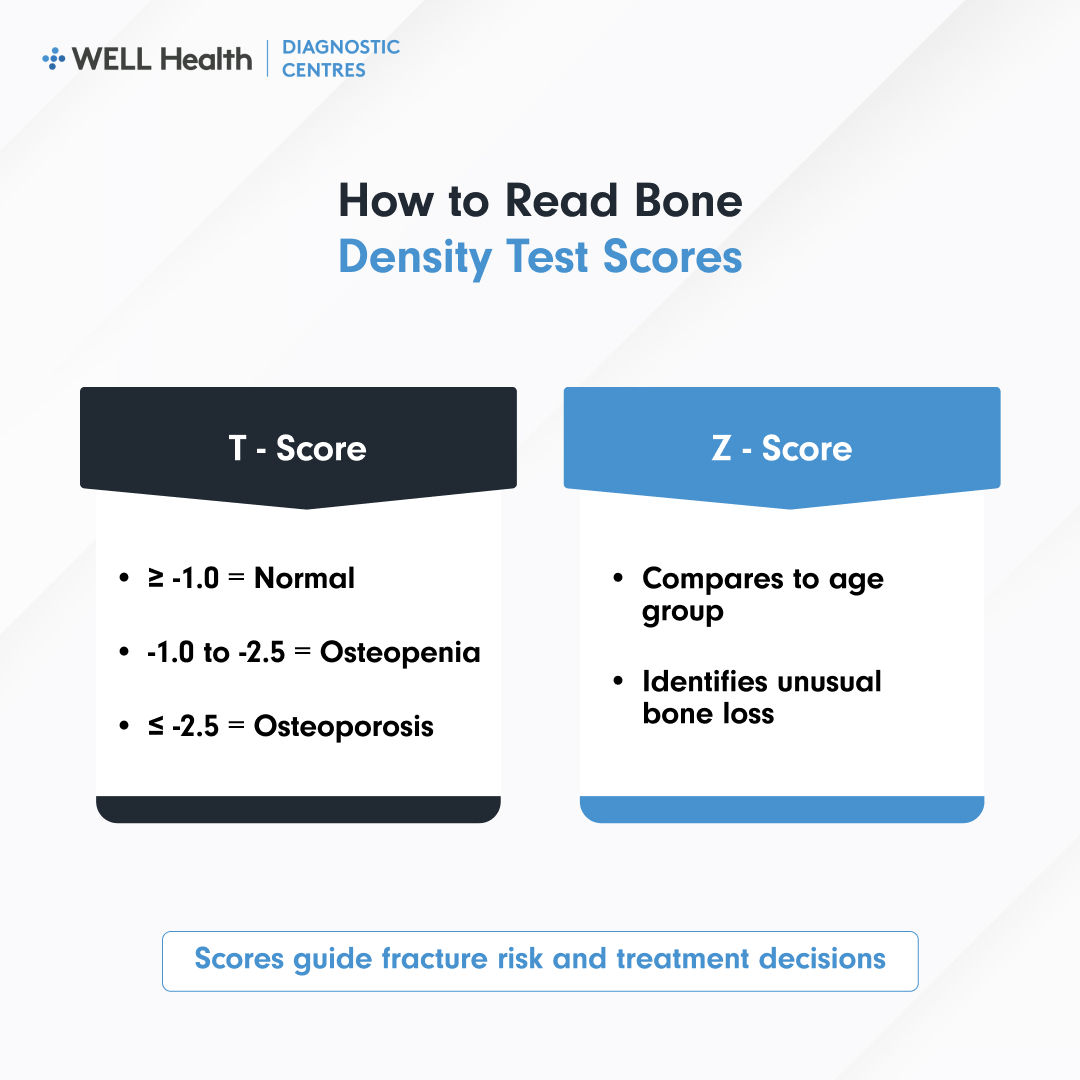
Results from a DXA scan are reported as two types of scores: T-score and Z-Score. T-Score compares your bone mineral density to your healthy peak, while Z-Score compares it to the ordinary people of your similar demographic.
T-Score
The T-score compares your bone mineral density to the average peak density of a healthy young adult of the same sex. According to the Bone Health and Osteoporosis Foundation, a T-score of -1.0 or above is classified as normal bone density. A T-score between -1.0 and -2.5 indicates low bone mass, also called osteopenia.
A T-score of -2.5 or below meets the World Health Organization’s diagnostic threshold for osteoporosis. T-scores are used for diagnostic classification in postmenopausal women and men aged 50 and older.
Z-Score
The Z-score compares your bone mineral density to the average for people of your same age, sex, and ethnicity. The NIAMS guidance states that a Z-score of -2.0 or lower is classified as below the expected range for your age.
Z-scores are used in premenopausal women, men under 50, and children, populations where T-score thresholds do not apply. A very low Z-score may suggest that a secondary cause, such as a medication or underlying disease, is contributing to bone loss.
What Results Indicate Clinically
A T-score alone does not determine the full clinical picture. The Manitoba Health bone density guidance for primary care providers states clearly that T-scores should not be used as a stand-alone result to guide management, and that many factors affect fracture risk beyond bone mineral density. Age, a history of prior fragility fractures, parental hip fracture, low body weight, tobacco use, and high alcohol intake all contribute to fracture risk independently of the T-score.
FRAX Fracture Risk Tool
Most DXA reports for patients over 50 include a FRAX score, a 10-year probability of a major osteoporotic fracture and a hip fracture. The FRAX tool incorporates the femoral neck bone density alongside clinical risk factors to produce a probability estimate. Your physician uses the FRAX output to categorize your fracture risk as low, moderate, or high, and to decide when pharmacological treatment is appropriate.
Risk Classification Based on Results
Clinical guidelines in Canada classify fracture risk in three categories, which guide treatment decisions. The Manitoba Health bone density reporting framework, based on the 2010 Canadian clinical practice guidelines for osteoporosis, outlines these categories.
- Low risk: Lifestyle measures are sufficient; pharmacological therapy is generally not indicated.
- Moderate risk: Requires careful evaluation for vertebral fractures or additional clinical risk factors before deciding on treatment.
- High risk: Pharmacological therapy is typically recommended; includes patients over 50 with a hip or vertebral fragility fracture.
- Very high risk: Patients with a T-score of -2.5 or below are considered at minimum moderate risk; those with prior fragility fractures are classified at high or very high risk regardless of T-score.
When Follow-Up Testing Is Recommended
Repeat DXA testing is recommended when results are likely to influence treatment decisions. The Bone Health and Osteoporosis Foundation guidance states that repeat testing is typically done 1 to 2 years after starting or changing osteoporosis medication to assess treatment response. For untreated patients near a treatment threshold, a repeat scan at 1 to 2 years helps determine if intervention has become warranted based on further bone loss. Subsequent testing frequency is individualized to each patient’s clinical situation.
Reporting and Physician Review
The DXA scan is analyzed by a radiologist or densitometrist, who prepares a written report including T-scores, Z-scores, the FRAX assessment, and any clinical observations about scan quality or confounding factors such as osteoarthritis. The report is sent to your referring physician, who reviews it in the context of your full medical history. Your physician discusses findings with you at a follow-up appointment and outlines next steps, including any referral to a specialist for osteoporosis management.
Frequently Asked Questions
What does a T-score of -2.5 mean?
A T-score of -2.5 means your bone mineral density is 2.5 standard deviations below the average peak density of a healthy young adult. This meets the WHO diagnostic threshold for osteoporosis. However, this score alone does not determine treatment, your physician considers it alongside your FRAX fracture probability and other clinical risk factors before recommending pharmacological therapy.
Is osteopenia the same as osteoporosis?
No. Osteopenia refers to bone mineral density that is lower than normal but has not reached the threshold for osteoporosis. It is classified as a T-score between -1.0 and -2.5. Not all patients with osteopenia require medication; treatment decisions are based on the overall fracture risk profile, not the T-score category alone.
How long does a bone density scan take?
A DXA scan at the hip and spine typically takes 10 to 20 minutes from positioning to completion. No preparation beyond avoiding calcium supplements for 24 hours prior is required for bone density testing. The scan is painless and does not require fasting or any change to your regular medications.
Understanding Your Bone Density Report
Your bone density report provides a starting point for assessing your fracture risk, not a standalone diagnosis. The T-score, Z-score, and FRAX probability are tools your physician uses alongside a complete clinical picture to determine what, if anything, needs to change. If you have questions about your result or what it means for your care, bring your report to your follow-up appointment and ask your physician to explain the FRAX output and recommended management.